
Lift, seal, resurface or replace
Concrete Repair & Leveling in Colorado Springs, CO
Find out whether your slab is sinking or heaving, and what that means for the fix.
- Free on-site measuring visit
- Line-item written quote you can compare
- Drainage and soil checked before we price
Sinking and Heaving Need Different Fixes
Concrete repair and leveling in Colorado Springs starts with one question: is the slab going down or coming up? Sinking usually means the ground underneath settled or washed out, and a sunken panel can often be lifted back into place. Heaving usually means the soil underneath swelled, and a raised panel cannot be pushed back down. The Colorado Geological Survey calls expansive soil Colorado's most significant geologic hazard, says some clays can expand up to 20 percent by volume when wet, and names heaved sidewalks, patios and driveways as very common signs. That is why we diagnose before we price.
Quick diagnosis
- Panel lower than its neighbor, still in one piece: a settled or washed-out base; usually lifted with slurry or foam
- Panel higher than its neighbor: swelling soil or roots; the edge is ground down, or the panel is cut out and repoured
- Fine flaking across the surface: freeze-thaw and de-icers; resurfacing works if the slab is sound
- Hairline cracks with no height change: shrinkage; sealed to keep water out
- Wide cracks and broken pieces: a failed base; the panel is replaced
Most slabs show more than one of these, and the quote addresses each.
Lifting
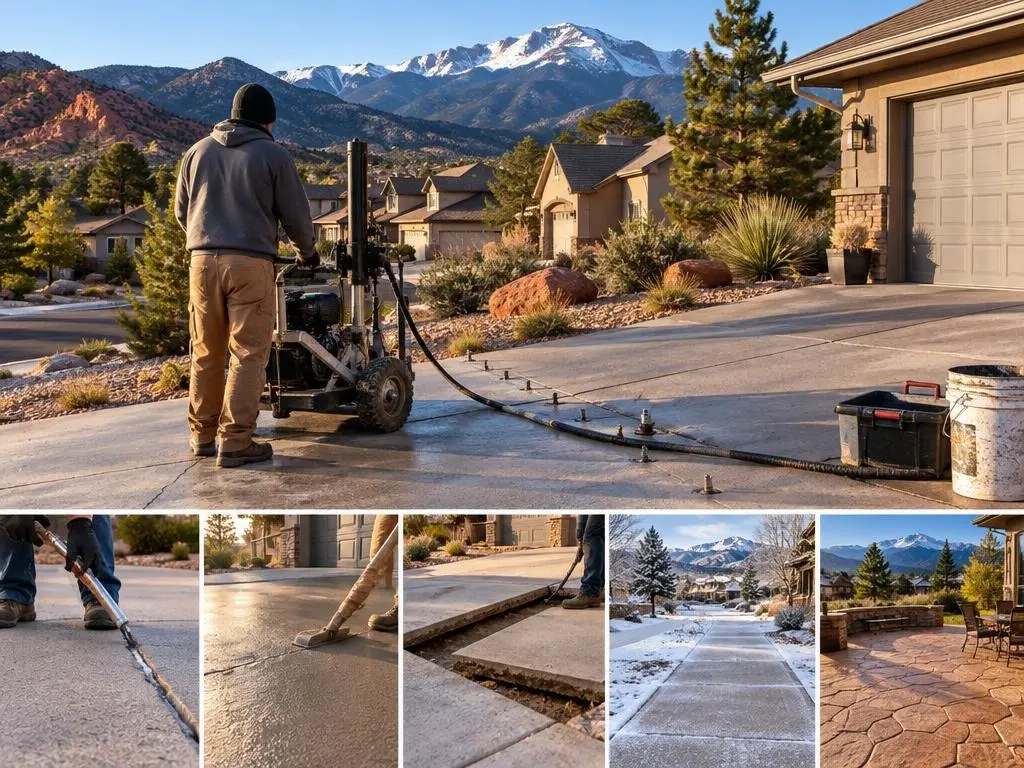
Mudjacking pumps a cement-based slurry under a sunken slab through small drilled holes, filling the void and raising the concrete. Foam lifting does the same with expanding polyurethane through smaller holes, adding less weight to the soil. HomeGuide's leveling guide lists mudjacking at $4 to $9 a square foot and polyjacking at $8 to $25, with typical minimum charges of $300 to $700, and says results last 5 to 10 years or more. Lifting suits settlement. It is the wrong tool for a slab that is being pushed upward.
Cracks and surfaces
Sealing cracks keeps water out of the base, which matters on clay. HomeGuide's resurfacing guide puts crack filling at $0.50 to $3 a linear foot and warns that cracks wider than about a quarter inch usually point to a deeper problem. For a slab that is solid but worn, a cement-based resurfacer can restore the top; HomeGuide lists basic driveway resurfacing at $3 to $5 a square foot, with a life of 8 to 15 years, and says a slab needing more than about 2 inches of new material should be replaced. Resurfacing a slab that is still moving just puts a new face on the same cracks.
Replacing only what failed
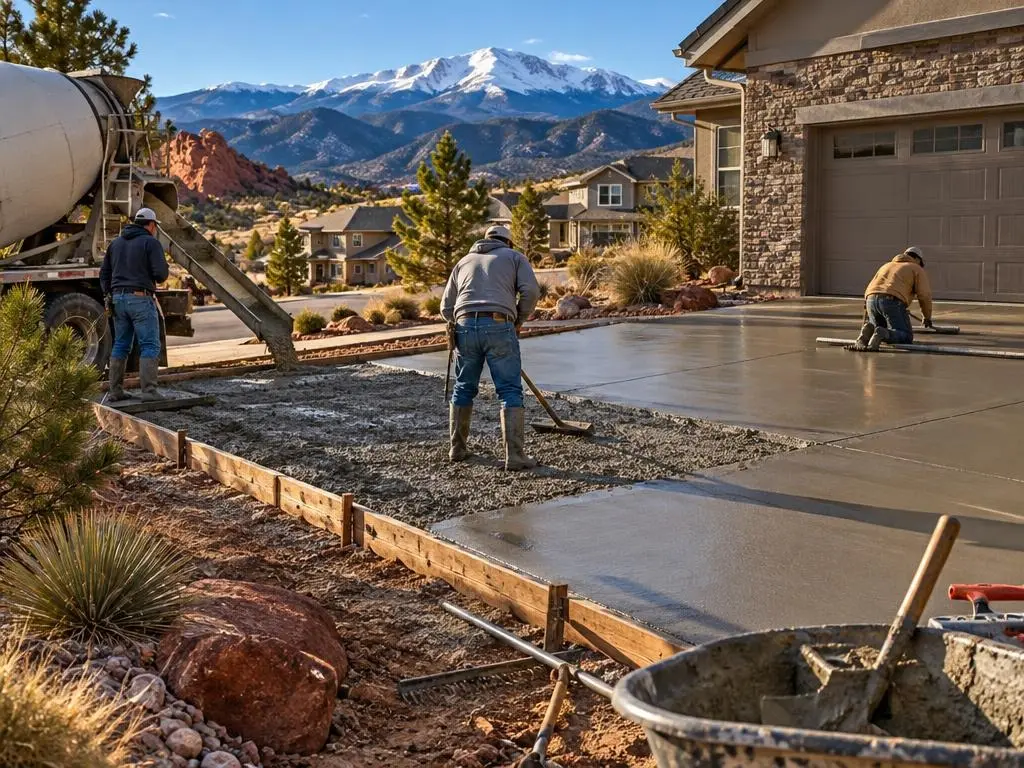
When one or two panels in a driveway or walk are broken and the rest are fine, we saw-cut along joints, remove the failed sections, correct the base, and pour new panels doweled into the old ones. A new panel will be lighter in color than weathered concrete for a while. If a uniform look matters, resurfacing the area afterward can even it out.
Fixing the water
Most of the concrete movement we price is tied to water. Before any repair, we look at where downspouts discharge, where sprinklers throw, which way the yard slopes and whether water collects along slab edges. The Colorado Geological Survey points to poor surface drainage and irrigation near foundations as common contributors to swelling-soil damage. A downspout extension or a regraded strip of soil can be the cheapest and most important part of the repair.
When replacement wins
If flaking covers most of the surface, cracks run through most panels, the slab keeps heaving year after year, or the repair price is approaching HomeGuide's $6 to $15 a square foot for new concrete, replacement is usually the better spend. We price both so the decision is yours.
Repair Options We Quote
Each option is priced for your slab, usually beside the cost of replacing it.
Mudjacking
Cement-based slurry pumped under a sunken slab to raise it.
Foam lifting
Expanding polyurethane injected through small holes to lift and support.
Trip-edge grinding
A raised panel edge ground down to remove a tripping hazard.
Crack and joint sealing
Flexible sealant to keep water out of the base.
Resurfacing
A thin cement-based layer on a sound but worn slab.
Panel replacement
Failed sections cut out, base corrected, new concrete doweled in.
Typical Concrete Repair Costs
| Job | HomeGuide range |
|---|---|
| Leveling, average per sq ft | $3 to $12 |
| Mudjacking, per sq ft | $4 to $9 |
| Polyjacking (foam), per sq ft | $8 to $25 |
| Leveling minimum charge | $300 to $700 |
| Crack filling, per linear ft | $0.50 to $3 |
| Driveway resurfacing, basic, per sq ft | $3 to $5 |
| Replacement for comparison, per sq ft | $6 to $15 |
Sources: HomeGuide's concrete leveling and concrete resurfacing cost guides, national averages. Access, slab size and the cause of the damage change the total. Real prices around Colorado Springs can land above or below these figures. The number on your written estimate, after we measure, is the price.
How a Repair Job Runs
1. Diagnose
Sinking, heaving or wear identified, along with the water source.
2. Compare
Repair and replacement priced side by side in writing.
3. Repair
Lifting, sealing, resurfacing or new panels, plus any drainage fix.
4. Prevent
Notes on sprinklers, downspouts, sealing and de-icers.
Why Choose Us for Concrete Repair & Leveling
Diagnosis first
We tell you whether the slab is sinking or heaving before quoting a fix.
Two prices
Repair and replacement side by side, so you can choose.
Concrete Repair & Leveling Questions
Mudjacking or foam: which is better?
Both lift sunken slabs. Foam uses smaller holes and is lighter; mudjacking usually costs less. HomeGuide lists $4 to $9 a square foot for mudjacking and $8 to $25 for polyjacking.
Can a heaved slab be lowered?
No. A raised panel can be ground at the edge to remove a trip hazard, or cut out and repoured after the base and drainage are corrected.
How long does leveling last?
HomeGuide says 5 to 10 years or more, with mudjacking usually toward the shorter end. Stopping the water that caused the settlement makes the biggest difference.
Will the repair match my old concrete?
Not right away. New concrete is lighter and blends over time. Resurfacing the whole area gives an even color if that matters to you.
Concrete Repair & Leveling Service Areas
- Concrete Contractors in Colorado Springs, CO
- Concrete Contractors in Old Colorado City, CO
- Concrete Contractors in Broadmoor, CO
- Concrete Contractors in Fountain, CO
- Concrete Contractors in Security-Widefield, CO
- Concrete Contractors in Stratmoor, CO
- Concrete Contractors in Cimarron Hills, CO
- Concrete Contractors in Falcon, CO
- Concrete Contractors in Peyton, CO
- Concrete Contractors in Black Forest, CO
- Concrete Contractors in Gleneagle, CO
- Concrete Contractors in Monument, CO
- Concrete Contractors in Woodmoor, CO
- Concrete Contractors in Palmer Lake, CO
- Concrete Contractors in Manitou Springs, CO
- Concrete Contractors in Green Mountain Falls, CO
- Concrete Contractors in Cascade-Chipita Park, CO
- Concrete Contractors in Woodland Park, CO
- Concrete Contractors in Divide, CO
- Concrete Contractors in Calhan, CO
- Concrete Contractors in Ellicott, CO
Get a Concrete Repair & Leveling Estimate
A straight answer on repairing versus replacing, anywhere around Colorado Springs.